StarRotor has focused most of its early technology commercialization efforts on the development and testing of prototype compressors.
Efficient Compressors
In addition to being smaller and lighter than other types of compressors, prototype tests have demonstrated that StarRotor gas compressors are substantially more efficient than competing technologies at comparable scales, and maintain their efficiency over a wide range of operating conditions and speeds. In particular, prototype StarRotor compressors have demonstrated efficiencies at smaller scales that competing compression technologies only achieve at much larger scales.
Compact
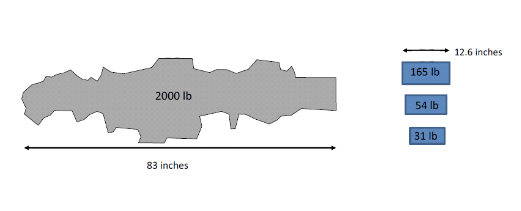
Most of the volume and mass of a StarRotor compressor is dedicated to actually processing the gas, instead of to complex systems of pistons, rods, cams, and valves. Because all chambers operate with every turn, the working displacement is also used more effectively. This can make a very significant size and mass difference!
Flexible Flow
In general, changing the speed of a positive-displacement compressor produces a corresponding change in flow rate, with relatively little impact on the compression ratio. In practice, the operating requirements of the machine (harmonic vibration, oscillating loads, valve timing, etc.) often limit this flexibility. With dynamic machines, both flow rate and compression ratio depend on the speed. When dynamic machines operate outside of their narrow design envelope, efficiency and effectiveness fall off dramatically. StarRotor machines have demonstrated an unusual degree of flexibility in operating at speeds ranging from a fraction to a multiple of design speed, with little impact on efficiency and no disruptive vibrations.
Low-Density Gases
Many compressors can handle low inlet pressures and densities, but few can do so economically. Dynamic machines require high flows and consistent conditions to operate efficiently. Reciprocating machines need very large cylinders for low-pressure applications. StarRotor compressors use their volumetric displacement efficiently like dynamic machines, allowing them to be compact. But they keep the flexibility and higher pressure ratios of positive-displacement machines, allowing them to handle smaller and more variable flows.
Wet Gases
Most compressors respond poorly to suspended liquids. Droplets damage valves in reciprocating machines, and destroy the fast-moving vanes of dynamic machines. The rotors of StarRotor gas compressors have relatively low surface speeds, making them much less susceptible to droplet erosion. This advantage is also particularly important for expanders.
Low Pressure Ratio Applications
The efficiency of reciprocating machines falls off dramatically at low pressure ratios. Dynamic machines can be efficient at low pressure ratios, but do poorly under variable conditions. The pure rotational motion of StarRotor compressors makes them highly efficient, even at low pressure ratios, while their positive displacement flexibility makes them adaptable to a wide range of flow and pressure conditions.
Quiet
Because the motion of StarRotor machines is purely rotational, with no oscillating masses, our compressors do not experience the heavy vibrations associated with most positive-displacement technologies. The primary sound is the flow of gas from the exit port as each chamber passes. Because all chambers pass in succession during each rotation, the flows are divided into smaller, smoother pulses at high frequencies that are much easier to muffle than the low-frequency vibrations of reciprocating machines.
Simple and Robust
The design of StarRotor compressors is elegantly simple. Their parts counts are low. They do not need the complex assemblies of cams and valves that are a major point of failure for reciprocating machines. There are no tip seals or piston rings to wear out. They do not have fragile vanes and complex gas flows, nor do they require the high precision in three dimensions that drives up the cost of screw compressors. The gerotor geometry is essentially two dimensional, and can be manufactured using conventional CNC equipment.
Dry
Unlike most screws, and some other compressor types, StarRotor compressors do not require oil flooding to seal the working space. The working fluid is not exposed to lubricants or other contaminants, avoiding the need for costly and problematic separation downstream.